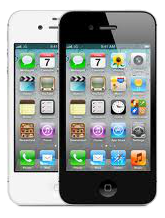
 If you’ve even casually glanced at my site or social stream then you’ll know that I’m an Android fan. I am an Open Source enthusiast, in favor of Copyright and Patent reform, so on and so forth. So what am I doing with an iPhone?
It was actually issued to me for work. My Blackberry Bold 9000 was dying, and people in our enterprise have been gravitating away from Blackberry to iPhone, so it was the logical choice. Work doesn’t allow Android devices yet, but our management solution can handle it (as well as Windows phone), so it is not far off.
For my personal phone I use a DroidX on Verizon (running stock Android 2.3.4, aka Gingerbread). I love the Droid and it has served me well.
The Blackberry also served me well for that matter. I disliked moving to a non-touch screen (previous work device was a Treo 650 and personal was the original Android G1), but I really did enjoy the hardware keyboard. I only used the Blackberry for mail and calendar, so the lack of a touch screen wasn’t too big of an issue. I could have done with a larger screen, though.
I have played with a few iPhone iterations, but never “got” it. I didn’t see what all the fuss was about. Once ordered, my expectation was that after I lived with an iPhone for a few weeks that I’d fall in love with it and “join the fold” so to speak. Well, it’s been a couple weeks and that hasn’t happened yet.
I’ve gone from mild amusement and admiration for the hardware design to mild contempt. Below I’ll hit the major points of the device compared to the other devices I’ve extensively used.
Screen
The screen truly is a beautiful display. Nice and crisp, vivid colors, and good lighting.. but it is so tiny! Comparing the size to my DroidX is like comparing the iPhone screen to the Blackberry. The super duper resolution of the retina display causes text to be on the small side which isn’t too bad for web pages and such since you can zoom. The accessibility options leave much to be desired, though. Rather than increase overall font sizes it allows you to “triple finger tap” to zoom in, then pan around the zoomed screen.
My eye sight is good, so I’m OK with this, but I think it’s something for those with low vision to keep in mind. No surprise, I prefer the accessibility options in Android’s current 4.x incarnation (aka Ice Cream Sandwich) which acts more like traditional operating systems by adjusting font and icon sizes. Gingerbread doesn’t do this, so if you need it make sure the device you choose has ICS or better. ICS doesn’t quite go far enough since it will not globally change fonts in applications, but I think it’s better than Apple’s choice.
Keyboard
I think this is my biggest gripe with the device. Spacing is OK, and the clicky sound feels natural, but text predictions are limited and the implementation sucks. Text predictions help immensely when typing on the go, and trying to get thoughts down on a small mobile screen. I hardly notice when IOS is predicting for me so blow past the words. When I do pause and look it’s usually wrong in the single guess as to what I want to type.
Another issue is that special characters and numbers require hitting an extra button. Even worse, really common special characters (#, +, *) require hitting a second special button to get to. This is particularly frustrating when you use secure passwords for your lock screen and web sites. Between shift and symbol keys it takes 12 key presses to type in an 8 character password. The Android method of “long pressing” to get numbers and symbols is far more elegant.
I do prefer IOS’s method for zooming through already written text, as well as selecting text to copy. Copy/paste came late to IOS, but they implemented it well.
The clincher for me is that you can’t download alternative keyboards. This is the first place that the locked down Apple experience really started annoying me. Other areas include the App store, the browser, and a few other app areas.
I even preferred the Blackberry hardware keyboard. It too had annoyances with regard to special characters, but doing selections copy/paste with the shift key and trackball worked great.
Unforeseen is that the iPhone keyboard is actually causing me to make more mistakes on my Android phone! Luckily, my existing prediction history and excellent auto correction is helping maneuver this bump. Hopefully my brain will auto compensate for this once I get used to the IOS keyboard.
Siri
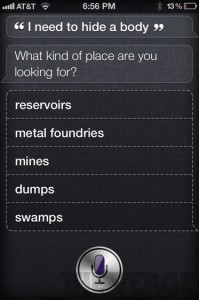
One of the break out features of the iPhone 4S, and in fact what the “S” stands for is Siri. When this feature was first announced I predicted that it would largely be unused. I haven’t seen difinitive proof one way or the other on this but it seems to be the case, and will likely hold true for me.
The voice recognition is excellent – better than Android’s, but that’s not my issue. The two primary drawbacks to me are that it takes several seconds for Siri to analyze what I’m saying and more often than not she has no idea what I want.
It works well for doing the things in the Apple commercial, but when I try something that I think falls right in line with what Siri should do (for example, “how far away is Biloxi, Mississippi”) she returns brain dead search results that do not infer what I wanted. This is far from a “magical” experience.
Siri is pretty responsive when at home on wifi, but when out and about I can type a search for what I want faster than watching Siri’s blank screen, waiting for her to get it wrong.
I will continue to try queries, and I’m sure I will love the ability to quickly schedule appointments or place calls while I’m driving. I’ll come back and update the post if I do use Siri regularly.
Performance
This is another area that the iPhone really shines. It is responsive. It loads into apps and swipes across screens fluidly. Hands down, the best experience I’ve had with a phone in this regard. In my experience, most complex devices start this way, but things get gummed up once you’ve been using it for a few months, so I’ll check back in. My friends with iPhones never complain about them slowing down, so I think performance will continue to be great.
Camera
Another excellent mark here. The camera is wonderful. It launches instantly and the pictures are great. Overall a much better experience and better pictures than my DroidX. I plan on moving to a Samsung Galaxy S III when I am eligible for upgrade and I can’t wait to take the cameras head to head. I’m pretty sure that the iPhone will still come out on top.
The photo gallery is much more responsive than my Droid as well. The android photo gallery can take forever to open up once you tap it. Once inside it is fluid, and if you re-launch it is fine the rest of the day but then (presumably) the process gets kicked out of memory and it takes forever to launch again.
Battery
Battery life is good, but not much better than my DroidX, so this is pretty much a wash. I easily go all day while using the phone pretty heavily and just charge each night as I sleep. I would prefer to have a removable battery with the option to buy something with a longer charge, but I think I’m OK with it. We’ll see in a couple years if the battery starts degrading.
The Blackberry battery is legendary. Well, not the battery itself (though it is removable), but the device’s power performance. You can use it heavily and still not have to charge it for days. This isn’t a fair comparison though, giving the limited processing power, limited data, and limited apps.
Apps
Yes, there are a bazillion apps in the App store. But you know what, just about any good app costs money and there are few demo or “light” versions. This is very frustrating coming from Android where it is more common to have ad supported apps with the option to buy an ad free version. I’m not even going to touch the fact that your only option is to use Apple’s store. I may throw the phone against a wall it frustrates me so.
The truth is, I’m rarely disappointed that an app is available for iPhone and not my Android. There are usually analogs that work just as well, or almost as well (and sometimes better) but are free. Yes, there are plenty of stinkers, but the power of user reviews and ratings makes steering clear of those easy.
I hear an area where the iPhone shines is music creation apps. Unfortunately, I can’t really take advantage of playing with these as it is a work phone. Blackberry app choices are abysmal. I’m sure there are lots more out there that I just never found, but I never experienced the same discoverability or ease of installing inherent in the Apple and Android stores.
Other Issues
I haven’t touched on a number of issues, but they’ve all been well documented by other people. Some are device specific, and some are more philosophical. I may write a blog post dedicated to these in the future. Among the other gripes are: the proprietary connector, reliance on paid Apple services for what I consider to be basic functionality, lacking configuration options in many areas (ie: Apple making choices for me instead of giving options), no removable storage, the perils of hacking and jailbreaking, poor task switching and app concurrency, minimal hardware buttons.. That’s most of them. Other small annoyances have cropped up as I’ve used it more.
The Scoreboard
Here’s where I give scores to these three devices. I will rate each aspect from 1 to 10 (10 being best). Best possible score is 100. Let’s see how they did.
| Feature: | DroidX | iPhone 4S |
Blackberry Bold 9000 |
|---|---|---|---|
| Overall Experience | 9 | 7 | 4 |
| Screen | 9 | 7 | 4 |
| Responsivness | 8 | 10 | 7 |
| Keyboard | 9 | 4 | 8 |
| Battery Life | 8 | 9 | 10 |
| Apps | 9 | 8 | 3 |
| Camera | 8 | 10 | 4 |
| Configurability | 10 | 6 | 2 |
| Accesibility | 7 | 6 | 3 |
| Accessories | 9 | 9 | 5 |
| Final Score | 86 | 76 | 50 |
OK Apple fans – now it’s your turn to tell me why I’m completely wrong and how I still don’t get it. It has only been a couple weeks, so I’ll come back and update the post in the next month to see if I still feel the same way.